
FRACTO™ Unpacked: How Functional Dependency Predicts Friction Before it Starts
In complex systems like healthcare, dependencies are everywhere — between a diagnosis and its documentation, a claim and its codes, a staffing model and the workload it carries.
This is the realm of Functional Dependency — the “F” in FRACTO™.
It’s where misalignment begins — and where the FRACTO™ engine starts its evaluation.
What Is Functional Dependency?
Functional Dependency is the real-time mapping of how clinical, operational, and financial data elements rely on each other to drive outcomes. It’s more than a technical link — it reflects the causal relationships that shape performance.
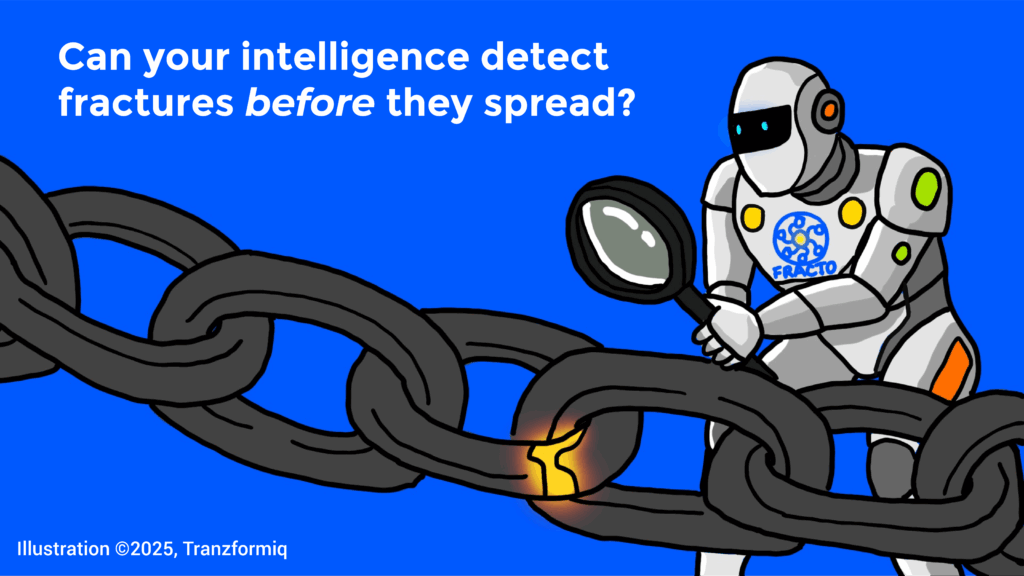
FRACTO™ monitors these relationships continuously, identifying breaks in the chain before they cause friction.
In healthcare, that might look like:
- A diagnosis code with no narrative support in the clinical note
- An authorization denial triggered by an incomplete problem list
- A modifier left off due to broken charge pathways
- An underpayment tied to weak DRG documentation
These aren’t just workflow errors — they’re signals of dependency failure, and FRACTO™ treats them that way.
Why It Matters
Healthcare operates on chained assumptions:
- Coders assume documentation will support severity
- Revenue teams assume codes are audit-proof
- Prior auth teams assume medical necessity is captured
When one link fails, the whole chain breaks.
By applying systems thinking — as Peter Senge describes in The Fifth Discipline — we stop treating breakdowns as isolated errors. We see them as feedback loops. And as Donella Meadows reminds us: feedback isn’t noise. It’s signal.
FRACTO™ listens.
And in the spirit of Wolcott & Krippendorff’s Proximity Revolution, it doesn’t just listen–it acts in context. It brings intelligence closer to decision points, catching issues early, before they cascade downstream.
A Mnemonic for Intelligence
The FRACTO™ engine monitors six dynamic elements — each shaping how dependencies are modeled and orchestrated in real time:
- F – Functional Dependency & Resource Load Evaluates how documentation supports DRG weight, length of stay, and financial complexity
- R – Reimbursement Alignment Checks consistency with payer contract logic and expected payment
- A – Acuity from Clinical Context Surfaces patient severity and risk from structured fields and clinical notes
- C – Claims Pattern & Historical Denials Applies denial history and edit logic to flag submission risk in real time
- T – Treatment & Procedural Complexity Measures alignment between services rendered and procedures coded
- O – Operational & Encounter Burden Surfaces workflow gaps, staff strain, and pre-submission process friction
These aren’t siloed metrics — they behave as a living system. A shift in one can ripple across all six.
Feedback That Fuels Intelligence
The power of FRACTO™ lies in its feedback loops:
- Coders get early signal when documentation doesn’t align
- Providers are nudged to clarify complexity in real time
- Payers are preemptively aligned with expected adjudication
- Revenue teams focus on claims most at risk
This isn’t automation. It’s orchestration. And it starts with functional dependency.
These loops don’t run in the background — they continuously shape a real-time intelligence layer. FRACTO™ distills that complexity into a single, actionable signal: the FRACTO™ Score.
We’ll unpack that composite score — and how it drives smarter decisions across the enterprise — later in this series.

About R-IQ
R-IQ is an AI-powered revenue cycle platform that uses deep learning to predict denials, validate claims, and optimize billing workflows—before errors happen. It’s built to replace costly friction with real-time intelligence.
Join the Journey
Follow us and share your perspective. Each week, we’ll spotlight a key issue driving up collection costs—and how we can reverse the trend together.
Where are you seeing the Cost to Collect show up in your world? We’d love to hear how your team is navigating this challenge.