Reimbursement Alignment: Navigating the Complex Payment Landscape with FRACTO™
Healthcare’s Achilles’ heel isn’t clinical quality — it’s financial misalignment. Hospitals and health systems deliver life-changing care every day, yet too often fail to translate that care into proper reimbursement. According to a 2022 Change Healthcare report, approximately 11% of hospital claims are initially denied, contributing to billions in lost revenue each year.
The U.S. payment landscape is a patchwork of models — DRG-based reimbursements, fee-for-service (FFS), carve-outs, and value-based agreements — each introducing its own risks for underpayment and misalignment. For organizations striving to balance clinical excellence with financial stability, navigating these models can feel like walking a tightrope. That’s exactly why AI-driven systems like FRACTO™ are essential: they provide the intelligence needed to align documentation, coding, and payment logic across all reimbursement structures.
Manual processes and traditional rules engines often fail to keep up with the complexity of payer-specific requirements. A DRG claim might lack critical documentation. An FFS claim might miss a billable service. A capitation model might understate patient risk. These gaps lead to revenue leakage and denials — costing the industry billions in avoidable underpayments and weakening a health system’s ability to invest in care and innovation.
Understanding CDI, DRG, and Misalignment Costs
Clinical Documentation Improvement (CDI) programs are critical to ensuring that patient records accurately reflect the complexity of a condition. CDI directly affects Diagnosis-Related Group (DRG) assignment, which drives reimbursement under many models. When documentation lacks specificity — such as omitting comorbidities or secondary diagnoses — the assigned DRG can reflect lower acuity, reducing payment.
Misalignment between clinical narratives and coding logic can result in:
- Lower-weighted DRGs, which understate patient severity and reduce reimbursement
- Increased denial risk, as payers flag claims lacking clear medical necessity
- Missed revenue opportunities, as underreported complexity affects both FFS billing and value-based compensation
FRACTO™ strengthens CDI and DRG accuracy by monitoring real-time clinical inputs, flagging documentation gaps, and predicting how coding decisions impact reimbursement — without conflating charge capture, which remains a distinct process.
An Intelligence Engine Built for Complexity
FRACTO™ is an adaptive intelligence engine designed to manage this complexity. It continuously monitors:
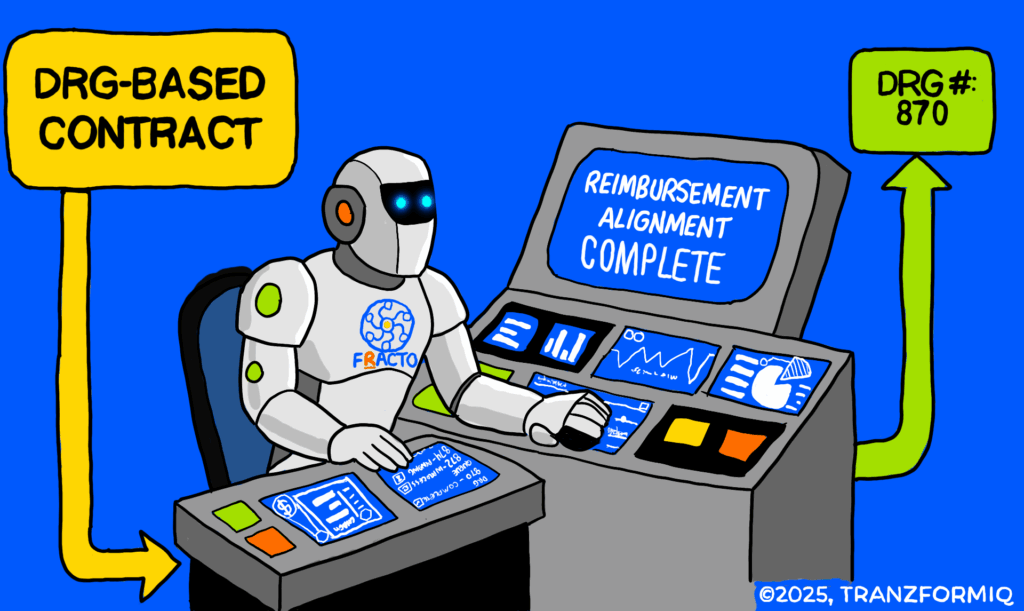
- DRG-based models, ensuring documentation supports accurate coding and DRG assignment, while predicting reimbursement based on payer contracts
- Fee-for-service models, confirming that all rendered services are fully documented, coded, and billed
- Bundled and value-based models, tracking risk adjustment, quality measures, and care gaps that affect payment and compliance
By leveraging ML-powered contract learning, FRACTO™ delivers real-time feedback to surface gaps and prevent revenue loss before claims are submitted.
As Peter Senge wrote in The Fifth Discipline, resilient systems recognize their own feedback loops. In healthcare, documentation, coding, and reimbursement form one interconnected system. Donella Meadows, in Thinking in Systems, reminds us that resilience comes from understanding these dynamics. FRACTO™ applies these principles in real-time, delivering insight close to the point of action — a practical expression of Wolcott & Krippendorff’s Proximity Revolution.
Where FRACTO™ Delivers Measurable Impact
- A DRG claim at risk of downcoding due to missing comorbidities is corrected early — boosting revenue and reducing audit exposure
- A missed ancillary service in an FFS model is flagged and posted before billing — ensuring full payment for all rendered care
- A bundled contract benefits from accurate risk stratification — securing fair compensation for high-acuity patients
Health systems can’t thrive without aligning financial integrity with clinical performance. FRACTO™ ensures every service is recognized, every diagnosis is supported, and every payment model is optimized. This isn’t about chasing dollars — it’s about building a sustainable ecosystem where financial resilience fuels better patient outcomes.
Reimbursement alignment is just one element of the FRACTO™ engine. In the next article, we’ll explore Acuity Contextualization — how FRACTO™ matches patient complexity with true revenue integrity, ensuring clinical severity and risk are captured with the same precision as the care delivered.

About R-IQ
R-IQ is an AI-powered revenue cycle platform that uses deep learning to predict denials, validate claims, and optimize billing workflows—before errors happen. It’s built to replace costly friction with real-time intelligence.
Join the Journey
Follow us and share your perspective. Each week, we’ll spotlight a key issue driving up collection costs—and how we can reverse the trend together.
Where are you seeing the Cost to Collect show up in your world? We’d love to hear how your team is navigating this challenge.